After filing an U.S. naturalization application (form N-400), going for an interview, and taking a naturalization test, you will be scheduled for an Oath of Allegiance.
Unfortunately, getting a schedule for the swearing-in ceremony can take a long time, even months from when U.S. Citizenship and Immigration Services (USCIS) informed you about it in your interview. The good news is that you’re almost one step away from becoming a U.S. citizen.
If you experience this, it’s best for you to find out why the schedule of your oath ceremony takes so long. Let’s discover it below!
What is the Oath Ceremony?
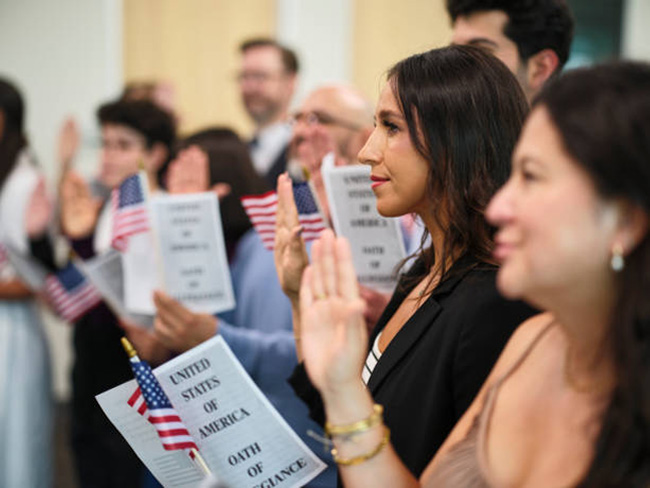
An oath ceremony, officially known as the “Oath of Allegiance,” is a sworn statement ceremony carried out by each individual to become a naturalized United States citizen. It is such a promise to meet their obligations as a new citizen.
Historically, this ceremony is not a new tradition because it has been around since the 18th century. Based on a Congressional resolution of February 3, 1778, the oath of allegiance was initially conducted by officers of the Continental Army during the Revolutionary War.
In accordance with the Naturalization Act of 1790, an Oath of Allegiance was imposed on every prospective citizen of the United States that required them to make a promise (without written text) to support the United States Constitution.
As time went by, the Naturalization Act continued to be charged by adding a few policies, such as adding a rejection of the oath of sovereignty of new citizens (the Naturalization Act of 1795), adding the obligation of new citizens to defend the U.S. laws and constitution from various threats, and also having true loyalty toward the same (the Naturalization Act of 1906).
In 1929, every individual who took the oath of allegiance could obtain a written text, where previously only verbal oaths were available. In practice, each court could develop its own procedure for administering the oath.
Additional text regarding bearing arms and performing non-combat service in the United States armed forces was added under the Internal Security Act of 1950.
Then, the Immigration and Nationality Act of 1952 added matters related to carrying out work of national interest under civilian direction.
What’s in the Current Oath of Allegiance?
After undergoing many changes, the executive branch established the current Oath of Allegiance in the form of administrative regulations.
Theoretically, the CIS is authorized to change the text of the oath at any time, as long as it meets the “five principles” mandated by the Immigration and Nationality Act of 1953.
Basically, there are five principles on the Oath of Allegiance that every prospective new U.S. citizen should follow, including:
- Surrender allegiance to the Constitution of the United States.
- Providing defense of the Constitution against threats originating from within and outside the country.
- Giving a refusal of allegiance to a foreign country where they have been residents of a country before.
- Provides a promise to carry out civic duties in the national interest if they are called upon by the government.
- Promise to serve in the United States Armed Forces if they are required to by law (either combat or non-combat).
Although the Oath of Allegiance was amended again by the CIS on Citizenship Day (September 17) in the fall of 2003, the U.S. House of Representatives Judiciary Subcommittee on Immigration, Border Security, and Claims rescinded the change on April 1, 2004.
When and Where is an Oath Ceremony Conducted?
When it comes to the time and place to conduct an oath ceremony, it will depend on the state. In most U.S. jurisdictions, USCIS is a designated location to administer an oath of ceremony, but some appoint a federal court to do it.
An oath ceremony will be scheduled by USCIS after you’re approved for both your naturalization application and your interview and written test.
USCIS will either allow you to take an oath ceremony on the same day upon naturalization interview or make a schedule with you in advance by sending an appointment letter via mail containing the “Notice of Naturalization Oath Ceremony” (Form N-445).
Why is Your Oath Ceremony Taking So Long?
USCIS informed you that it is possible that you will soon take an oath of allegiance, but for several months, you’ve not yet received a schedule for the oath ceremony.
You don’t have to worry since it is a common problem that happens at USCIS. Reportedly, many U.S. naturalization applicants experience it.
Of course, there may be several possible reasons why your oath ceremony is outside the normal processing time, including:
1. Request a name change
Usually, this is the strongest reason why you’ll get delayed for the oath ceremony. When you apply for a name change, USCIS will transfer your application to the federal government, as only federal courts can do.
Instead of doing it one by one, they will probably gather it all together before scheduling you all together, so that an oath ceremony can be done at the same time. The waiting time for it is up to 6 months. That’s why your oath ceremony takes so long.
2. Security checks have not been carried out
Before USCIS approves and ultimately grants you citizenship, the Federal Bureau of Investigation (FBI) will first conduct a security check to confirm that your name is clear of any legal cases.
If this has not been completed, it will cause delays, especially if you have the same name as someone who is considered a threat to national security.
3. There’s any error
It cannot be denied that data, technical, and human errors are possible, even at a large agency like USCIS. Naturalization applications that are backlogged due to an error system or lost files can cause delays in the verification process. If it happens, USCIS will not immediately send you a schedule for the oath ceremony.
4. An appointment letter gets lost
Last, the notification letter for the oath ceremony may have been sent by USCIS but lost during delivery or at the post office, assuming that you have not changed your address in the days since your interview.
Of course, this will slow things down. You might think USCIS hasn’t sent it yet. Also, USCIS assumes you ignored it.
What Can You Do If Your Oath Ceremony Gets Delayed?
If you haven’t yet received a notification letter for the oath ceremony, you can do several things that may help you. Here they are:
1. Contact USCIS
Contacting USCIS customer support is all you need to do. Make sure to always be patient since you may be in a telephone queue, so you won’t be able to speak directly to a representative.
Before making a phone call, you should prepare the necessary documents, such as a green card, a copy of the naturalization form, etc. Sure, they may ask these for information.
2. Visit a local USCIS office
If USCIS representatives cannot handle your request, you can consider visiting a USCIS officer nearby. You also need to bring your green card, the letter of approval from USCIS you got at the end of your interview, and any necessary documents.
3. Send a mail
To make it clearer, you can send a letter to the USCIS office, where a naturalization interview and test took place. Make sure to attach your A-number and a copy of your approval letter from USCIS. You can tell them why your oath ceremony is delayed.
4. Consult an attorney.
In the last step, you can hire an attorney. They may have information and resources regarding where to process it. An experienced person can help you find out the wait time in your region, so you can know when your oath ceremony will be held.
If Your Oath Ceremony is Scheduled, What Should You Bring?
Actually, there’s no preparation needed. You also don’t have to memorize the Oath of Allegiance since you’ll be given a sheet of paper to read.
Basically, what you should do is prepare any necessary documents and always follow the instructions on an appointment letter. The following are things you should bring to the oath ceremony:
- Your green card, also known as a permanent resident card, But you’re not required to bring it if yours was lost or stolen, as you provided during the interview, or if you apply for it based on qualifying military service.
- Your appointment letter (Form N-445). It may contain the questionnaire that you must complete prior to arriving at the ceremony. USCIS will then review your answer to know whether or not there’s any change to your personal data.
- A government-issued photo ID. It could be either your driver’s license, state ID, or passport.
- USCIS-issued travel documents. It could be your re-entry permit and refugee travel document, if necessary.
- Other documents. You should bring any documents to your oath ceremony if you forgot to bring them to your interview.
About the dress you should wear to the oath ceremony, USCIS suggests you use modest attire to respect the dignity of the oath ceremony. The use of jeans, shorts, and flip-flops is prohibited.
What Should You Do During the Oath Ceremony?
Upon arrival at the oath ceremony location, either at the USCIS office or federal court, you’ll be inspected by officers to verify your identity. The documents you bring will be checked one-by-one, including the questionnaire you’ve completed, to determine whether or not you qualify for an oath ceremony.
If you’re eligible, the officers will ask you to provide your green card and USCIS-issued travel documents. These will then be replaced by a Certificate of Naturalization, Form N-550, at the end of the ceremony.
You may receive a set of materials during check-in, including:
- A welcome packet
- An American flag
- Citizen’s Almanac (Form M-76)
- A wallet-size pamphlet of the Declaration of Independence and U.S. Constitution (Form M-654)
Before the Oath of Allegiance starts, USCIS will present videos, music, and an opening speech from a “Master of Ceremonies” and may sometimes be a guest speaker.
Along with other applicants, you’ll be required to stand, raise your right hand, and state the Oath of Allegiance loudly in front of the USCIS officials.
At the end of the ceremony, the applicants will recite the Pledge of Allegiance and the closing statement from the Master of Ceremonies.
What Happened After Your Oath Ceremony?
After you’ve taken an oath of ceremony, you’re now a U.S. citizen. You’ll then receive a Certificate of Naturalization and automatically gain the privileges and obligations of citizenship.
Make sure to check the certificate to find out whether or not there are any errors. If you find one, it’s best for you to notify USCIS immediately. You can also directly update your SSN, apply for a US passport, and register to vote.
What If You Cannot Attend the Oath Ceremony?
If USCIS has sent you a schedule for the oath ceremony but you cannot attend it, you should return Form N-445 to the USCIS office where it will take place.
In addition, you also have to give a letter that explains the reason why you cannot attend the ceremony. Make sure to request a new schedule to take part in the ceremony.
Note: USCIS may reject your naturalization application if you do not attend repeatedly after they reschedule for an oath ceremony.

AUTHOR BIO
On my daily job, I am a software engineer, programmer & computer technician. My passion is assembling PC hardware, studying Operating System and all things related to computers technology. I also love to make short films for YouTube as a producer. More at about me…